

Radiopharmacy Day 2026
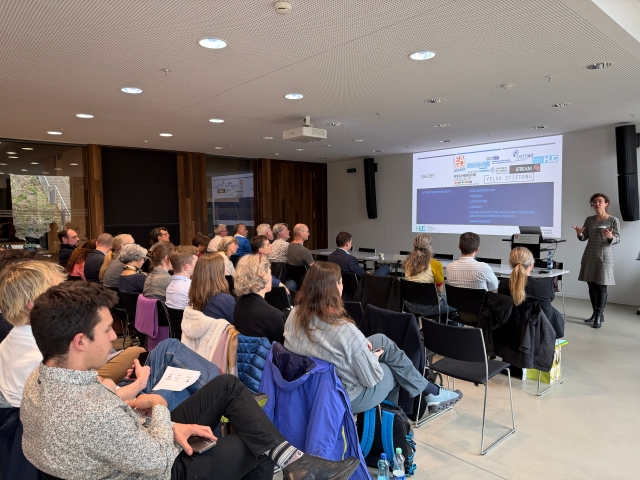
The Swiss Radiopharmacy Day 2026, held in Bern on March 11th, once again brought together leading experts from academia, industry, and regulatory bodies to exchange knowledge and discuss the latest advancements in nuclear medicine and radiopharmaceutical sciences. The meeting highlighted the dynamic and rapidly evolving nature of the field, with contributions spanning innovative radiochemistry, cutting-edge imaging technologies, translational research, and regulatory perspectives.
A central theme throughout the event was the increasing need for integration across disciplines to accelerate the translation of scientific discoveries into clinical applications. From novel radionuclides and advanced imaging biomarkers to ecosystem-level considerations and patient-centred approaches, the presentations collectively underscored the importance of collaboration in driving innovation and ensuring sustainable access to nuclear medicine solutions.
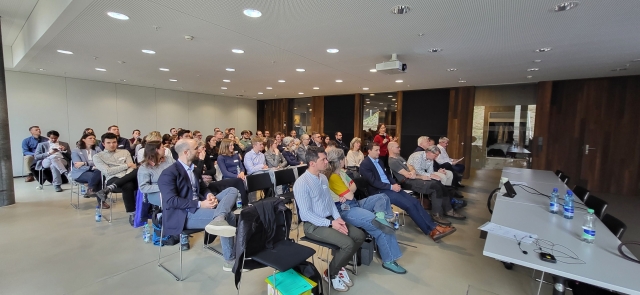
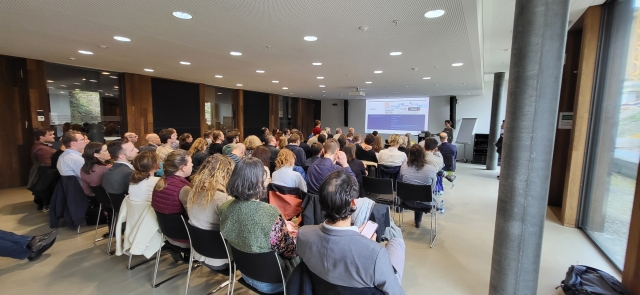
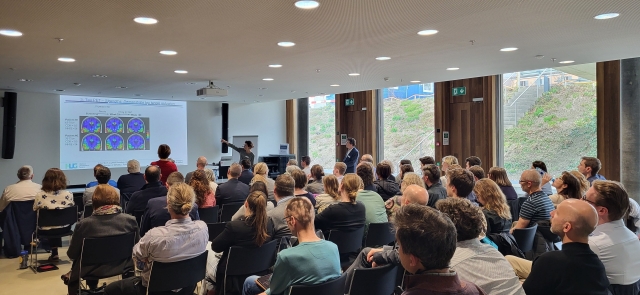
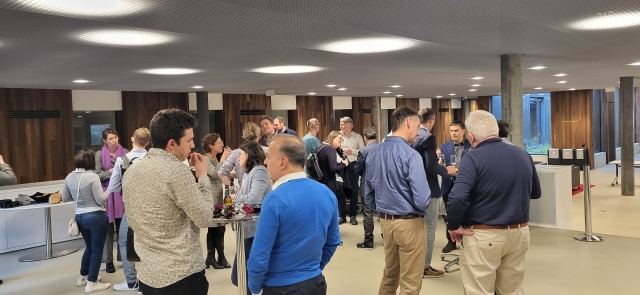
With excellent participation (80 participants) and a truly collaborative atmosphere, the event reaffirmed in perfect continuity with the 2025's event the importance of collective engagement in advancing our field. We take the chance to thank the FOPH for hosting our community.
The program featured a series of high-impact presentations of which we are happy to share with you a short summary below:
Nicolas Stritt (FOPH) presented the recent updates from the Swiss Federal Office of Public Health highlight evolving practices in radiation protection and radiopharmaceutical use.
In Switzerland, Lu-177 therapies remain stable, with updated release criteria reducing hospitalization from 48 to 20 hours, supported by new patient “living rules.”
A European survey (HERCA) revealed significant variability in release practices across countries, underlining the need for harmonization.
Quality assurance remains strong, with intercomparison studies confirming overall reliability in radiochemical purity measurements after corrective actions.
Ongoing inspections of Rb-82 generators and Y-90 therapies indicate high safety standards, despite increasing clinical use.
Several new clinical trials, including alpha-therapies and neuroimaging tracers, further reflect the dynamic growth of the field.
A presentation by Irene Corinovis on behalf of Lars Frieder Gerchow (PSI) introduced the PET4Pets initiative, an innovative approach leveraging interspecies oncology to advance precision medicine. The project addresses the gap between preclinical models and human applications by studying naturally occurring cancers in dogs. By combining PET detector development from ETH Zurich, radiochemistry expertise from PSI, and veterinary clinical practice, PET4Pets aims to establish dedicated PET imaging solutions for veterinary oncology. This approach not only improves diagnostics in companion animals but also provides a highly relevant and accelerated pathway for translating novel imaging agents and technologies into human clinical practice.
Cécile Philippe from the Medical University of Vienna presented recent advances in Immuno-PET, highlighting its growing role in visualising immune processes in vivo. Particular focus was given to innovative tracers, including small-molecule and metabolic probes such as [¹⁸F]FAC for imaging immune cell activity. The presentation also introduced the radioFlow technique, a novel methodology enabling high-resolution tracking of radiotracer dynamics at the cellular level. This approach opens new perspectives for understanding tracer behaviour and further advancing Immuno-PET tracer development.
Lukas Aebi (Nuklearforum Schweiz) addressed the complexity of organising a nuclear medicine ecosystem in Switzerland. The presentation emphasised the highly interconnected nature of the field, involving stakeholders across radionuclide production, radiopharmaceutical manufacturing, research and development, logistics, clinical practice, regulatory authorities, and patient organisations. It highlighted how fragmentation across this value chain can hinder innovation and limit patient access. Strategies to better align these actors were discussed, with the aim of ensuring that scientific advances translate into scalable solutions and reliable access to nuclear medicine services.
The keynote lecture by Valentina Garibotto (HUG), entitled “Molecular imaging in Alzheimer’s disease: from disease modeling to targeted treatments” provided a comprehensive overview of the transformative role of molecular imaging in neurodegenerative diseases. The lecture illustrated how imaging biomarkers targeting amyloid deposition, tau pathology, and neurodegeneration enable a more precise understanding of disease progression. These tools support earlier diagnosis, improved patient stratification, and the development of targeted therapies, ultimately contributing to more personalised and effective treatment strategies in Alzheimer’s disease.
Andreas Fürer (Swissmedic) detailed simplified drug authorization procedures under the TPA. Art. 13 allows for the recognition of foreign assessments from equivalent authorities like the EMA or FDA to speed up Swiss availability. Art. 14 focuses on "well-established use" products: substances known for 10 years (abis), OTC products used for 30 years (ater), or former cantonal licenses (aquater). While safety and efficacy reviews are simplified through literature data, a full and updated quality documentation remains mandatory. These procedures offer significant cost benefits, including a 60% fee reduction for Art. 13 and a 70% reduction for Art. 14 abis. Specific professional labels must also indicate the summary nature of Swissmedic's review.
Melpomeni Fani (USB) presented the development of Copper-61 (⁶¹Cu)-based PET radioligands, highlighting a successful Swiss bench-to-bedside translation. ⁶¹Cu emerges as a promising radionuclide for radiotheranostics, particularly due to its compatibility with the therapeutic counterpart ⁶⁷Cu. Clinical applications demonstrated improved lesion detection in prostate cancer using ⁶¹Cu-PSMA, particularly at delayed imaging time points compared to ¹⁸F-based tracers. In neuroendocrine tumours, ⁶¹Cu-labelled somatostatin receptor antagonists showed enhanced tumour-to-background contrast and superior image quality relative to ⁶⁸Ga-based standards. Early clinical data confirm favourable dosimetry, safety, and strong diagnostic performance, positioning ⁶¹Cu as a key contributor to future precision imaging and targeted radionuclide therapy.
Lorenzo Mercolli (Inselspital) introduced the emerging field of positronium lifetime imaging, presenting initial results obtained using a long axial field-of-view PET/CT scanner. This novel imaging approach explores the behaviour of positronium atoms in biological tissues, offering the potential to provide additional information beyond conventional PET imaging. The work opens new perspectives for tissue characterisation and may contribute to a deeper understanding of biological structures and disease processes.
Throughout the day, attendees emphasized the relevance and timeliness of the topics addressed, as well as the importance of maintaining a strong national network to support innovation, quality, and best practices.
The event featured the annual General Assembly, where key updates were presented and members had the opportunity to actively contribute to the strategic direction of the organization.
During the General Assembly the following topics were treated:
-
Honorary membership awarded to Markus Hummel, former society treasurer, for his outstanding contribution to our society
-
Appointment of the new treasurer Franziska Gygax, Solothurner Spitäler. A warm welcome from the society and best wishes for the mandate
-
Update statutes available on website
-
New Webmaster ad interim Anna Catherina Senn replacing Ruslan Cusnir. Thank you Ruslan for the commitment and best wishes to Anna for the new role
-
Communication Strategy: a year after. Objective set in 2025 have been successfully met and the strategy for 2026 has been presented. The key word is continuity and sustainable innovation
-
News from the Postgraduate Course / Certificate of Advanced Studies (CAS) “Radiopharmaceutical Chemistry / Radiopharmacy”. Postgraduate program offered by ETH Zurich and partner universities. It equips scientists and pharmacists with essential knowledge in GMP, radiopharmaceutical development, and European regulations—recognized by the EANM (https://radiochem.pharma.ethz.ch/)
-
Successful approval of society financials
-
News from the AGRR: collaboration with DGN and Grpw. ESRR coming soon
Speaking about continuous education, we would like to mention the CAS in Radiopharmaceutical Chemistry/Radiopharmacy to those who do not know yet the program.
CAS in Radiopharmaceutical Chemistry/Radiopharmacy is a postgraduate program offered by ETH Zurich and partner universities. It equips scientists and pharmacists with essential knowledge in GMP, radiopharmaceutical development, and European regulations—recognized by the EANM (link).
Are you interested in becoming an active member of our society and get the access to the society documentation (presentations, GA protocols and educative material) in our memberspace?
- Subscribe to our newsletter here
- Become a member, submit you application here